you will be able to see diamonds, spade and club ...small...can u find them? then click to navigate to another page...there is nothing wrong with the arrows...i design it in such a way...
left
About Me
My Name Is Victor and I play both classical and electrical guitar
8:24 AM
Saturday, February 14, 2009
Beautiful guitar that I found. Wondered how do you actually play the 2rd one. 12 strings X 2. wow, bet it must be tapping in this case. The one on the right looks appealing too, shiny finish with a cool colour. If I was rich, these guitar or at least 2 of them, would be added to my collection.
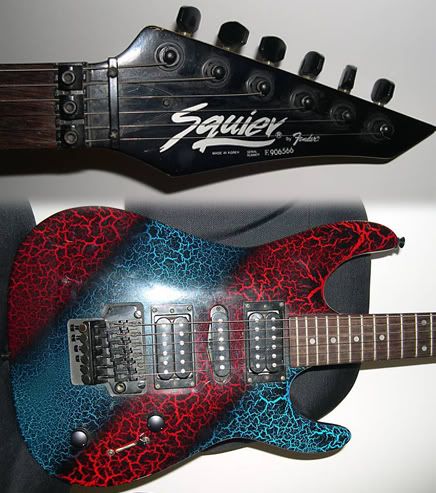
I wonder, why do I see so many people spelling squier wrongly? You see all sorts of werid spellings such as squire?
Searching through ebay, I was even more surprised to find people typing squier. So I wondered if ebay had link squire and squier together, for those people who can't spell?
Maybe some can't spell it because it isn't that famous afterall? No doubt, fender is confirm a more well-known guitar brand.
More frustrating, youtube videos include squire instead of squier! I really wonder if squier should even change it's name to squire!
My friends had shared with me about their encounter on guitarmasterpro! Thankfully, it was good news! My friend have progress really fast using this. He said, ''This $29.90 that i have spend is much better than any regular guitar class that you attend, which cost a bomb!'' He also commented that it took self-discipline for him too. He has learned to strum basic chords and some scales within 2days! What a good course! Do check it out!
I'm look for good guitar books to buy for my beginner friend. It's his birthday and he loves playing electric guitar. Is there any good beginner guitar books out there available for him? Apart from the most common book, dummies for guitarist?
Just probably teach him how to strum etc? Or probably some good documents I could get? Anyone knows? Please comment and let me know! Thanks!
Check this guitar out! Its so cool! It has a unique head. Some may find the colour too bright. But to me, it looks cool! Wished I could buy this guitar as part of my collection!
Guitar solos revolve around the improvisation of scales. Hence, knowing the scales very well will help you in learning guitar solo. I feel that the major, minor, harmonic and pentatonic scales are the most useful. Not only does it increase your overall movement, it also makes sure you use the correct fingering. Of course another important way to master guitar solos is to practice. The more you practice, the better you get, it is the law of nature.
Soloing is more than just a couple of scales, and patterns. It is used to express feelings. The pentatonic scales give a rather sad feeling. So, if one is looking to make a sad solo, he or she can improvise on one of the pentatonic scales.
I am going to give you an example, the Harmonic Minor Scale and the pentatonic minor; both are awesome and unique scales. Gary Moore used the Harmonic minor scale for blues sound, in the song 'I still got the Blues'. Hopefully, you can clearly see that solo are improvisation of scales.
If you don't improve your soloing with a bend, a pull-off, etc. Your solo may still sound like a scale. So what can you do in order to play a good solo?? First of all, you must know the key of the song. Mostly the key of a song is the first note you start playing on it. Always make use of techniques like bending, tapping and such to add colors to your solo. Take a look at dragon force ‘inside the winter storm’ or practically and dragon force songs, played by Herman Li, you will realize that his solo is filled with different techniques such as power chords, sliding, tapping and palm muting.
So, the bottom line is, master your scales before learning any guitar solo. Then, try to improve the solo using various types of guitar techniques.
There are couple of guitar equipments which you will need when playing guitar. For experts who go live on stage, a guitar strap is something that you definitely need to use. Without a strap, how are you even going to hold your guitar on stage?
Choosing a strap may be difficult to some extend. Here, let me share with you some tips on buying a guitar strap.
1) Top priority when buying a guitar strap is for it to feel comfortable. Nothing else matters when buying a guitar strap. Any other consideration should be off the list.
2) Make sure your guitar strap suits your music genre and personality. And finally, just note that until you become a rock god or some guitar idol, a guitar strap isn't one of those things you should take a mortgage for. Do not attempt to buy a guitar strap which doesnt suit your genre of music. Of course, do bear in mind priority number 1.
Ready to buy guitar strap now? Go check the different types of guitar straps available in the market! Be it fabric or leather guitar strap, you will need one if you intend to play live!
Did you take guitar lessons in high school? Can you strum a few bars of a Bob Dylan song, or play along with the Rolling Stones? If you are considering learning classical guitar, you are in for a whole new experience! Classical guitar is considered to be an art; one that has been practiced for hundreds of years. It has a history all of its own. Before you begin learning to play classical guitar, you will want to study its history and learn a few other things that make the classical guitar different from a regular acoustic guitar.
The main difference between classical and regular acoustic guitar is the way that you play them. A classical guitar has to almost become a part of you. Your body needs to move with the guitar as you play. Let yourself feel the rhythms and the melody and be caught up in them. If you are willing to take this approach, the music you play will have much more passion and movement than if you sit straight up and strum stiffly on the guitar.
Playing classical guitar requires the musician to be relaxed, both in mind and in body, and to become part of the music. Any thoughts or ideas you have of playing acoustic guitar will probably not apply to classical guitar. Be open to changing any habits or ideas that you have; this will help you to learn more quickly and to become a classical guitar player that people love to listen to.
Although classical guitar will seem difficult, take the time to learn the basics. Practice them over and over. If you do this, you will have a strong beginning to build on when you want to learn more complicated tunes and techniques. Practice and patience are very important when you want to learn classical guitar.
There are different ways to learn to play classical guitar. You can buy a book, CD or video, or even find information on the Internet. The most successful way to learn is to find a classical guitarist to teach you. It is much easier to learn how to sit, how to hold your guitar, and how to play the music if you have someone right there to show you and to correct you if you make any mistakes. Contact your local music store or put an ad in the newspaper to find a teacher. Enjoy this new learning experience, and if you feel discouraged, listen to a CD of a professional classical guitarist and look forward to the day you will be able to play that well!
Learning guitar scales is important, even if you think it almost as boring as learning chords. The problem with many new guitarists who have just started learning is that they want to go too far too soon. That is the road to disaster, as many failed guitarists will tell you.
Have you ever seen these piano players learning how to play, when they are going up and down the octaves playing their scales? Well, they are putting money in the bank because it will help them later when they have to play certain note combinations without thinking. If you are going to be a good lead guitarist, or a solo guitarist of any description in any genre, you too will have to spend time learning your guitar scales.
So, the question that many non-musicians ask. What are scales, and why are they so important? Scales are combinations of notes, ascending or descending, normally within an octave. The major scales are the basis of all other scales, and start and end on the same not. They go in the order whole-whole-half-whole-whole-whole-half-whole, the wholes and halves representing steps. Thus, for the scale of D: D - E - F# - G - A - B - C# - D.
Scales are chosen because they are melodic and harmonic, and once learned, they can be used to produce tunes that are pleasing to the ear. When learning guitar, you will come across the pentatonic scale, which is derived from the 1st, 2nd, 3rd, 5th and 6th notes of the corresponding major scale. Thus, the pentatonic D will be D - E - F# - A - B
There are a number of reasons for learning scales, one being that they are fundamental to learning the theory of music, and if your ambition is to become a classical guitarist, then you will also be required to learn about the theory of music. They allow you to learn about harmonics and pitch, and the effects of sharps and flats. Some note combinations are discordant to the ear, and scales will make it a great deal easier for you to compose a series of notes that will sound good.
Another reason, more important to guitarists, is that they enable you to play a series of notes without thought that will sound good, especially when played fast. Most fast guitar riffs and solos would sound meaningless if played slowly, but sound great when played fast. That is because they are based upon the pentatonic scales. You could conceivably use a major or minor scale, but with a pentatonic, you only have to learn combinations of 5 notes.
By learning a few pentatonic scales, you will be able to play fast guitar licks up and down the frets, using the same 5 notes in the same order. If you listen to the main solo in 'Bohemian Rhapsody', written by Brian May, that is played using a pentatonic scale, as is 'Eruption' by Eddie Van Halen. You can play the same notes over a number of octaves and it will sound great, because the notes are a scale that is pleasing the ear. Hence, the importance to a lead guitar player of learning guitar scales.
Once you get up on stage and start playing, you are not going to remember a complex series of notes to make up a rapid guitar solo. You have to play the notes by rote. If you have learned a guitar scale, the pentatonic in particular, you will be able to play anywhere on the neck of your guitar, as long as the notes are true.
Sure, you will have to change it for each string, and according to where on the neck you play it, but the notes will be the same and they will always be played in the same order. In practise, it doesn't matter to you if they are sharps or flats or neither: you are just playing the notes, and don't have to understand the theory. If you have learned your guitar scales properly, then you won't have to remember because of the muscle memory involved.
It's the same with chords. If you have learned your chords properly, you don't have to figure where to put your fingers, you just play the chord and you fingers automatically get them right due to the muscle memory of repetition and revision. You don't start a new song in your gig, and then wonder what the chords are: they come automatically, and so do the scales when you need them.
That's why learning guitar scales is important, and why you shouldn't screw up your face when asked to play them. It's money in the bank, that you will withdraw when you are finally standing alone in front of 10,000 screaming people and striking up the first note of your fabulous guitar solo. It's only dozens of repetitions of a pentatonic scale, but they don't know that - they think you are fabulous - a star- and all because you took the time to learn your guitar scales.